

A frozen air conditioner is one of those problems that catches homeowners completely off guard. You walk past the indoor unit and notice ice on the coils, or you step outside and find the refrigerant line wrapped in frost. If you’re asking why is my AC freezing up, the short answer is that something is preventing warm air from flowing across the coils the way it should. The longer answer involves a handful of specific causes, each with a different fix — and knowing which one you’re dealing with makes all the difference.
This guide covers every common reason an AC freezes, what you can do right now, and when the problem needs a licensed technician.
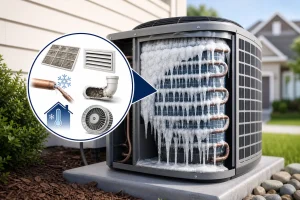
How an AC Coil Freezes in the First Place
Your air conditioner pulls warm indoor air across a set of evaporator coils filled with refrigerant. The refrigerant absorbs heat from that air and moves it outside. As long as warm air keeps flowing across the coils, the refrigerant stays cold — but not cold enough to freeze.
When airflow slows down, or when refrigerant pressure drops too low, the coil temperature falls below 32 degrees Fahrenheit. Moisture in the air condenses and freezes directly onto the coil surface. Once ice starts forming, it insulates the coil further, which causes more ice to form. The cycle feeds itself until the coil is completely encased and the system stops cooling altogether.
The root cause is almost always one of four things: restricted airflow, low refrigerant, a drainage problem, or running the system in conditions it wasn’t designed for.
The Most Common Reasons Your AC Is Freezing Up
Dirty or Clogged Air Filter
This is the single most frequent cause of a frozen AC — and the easiest to fix yourself. A clogged filter blocks the warm return air the evaporator coil depends on. Less warm air means the coil gets too cold, and ice follows.
Check your filter first. If it looks gray, matted, or visibly blocked, replace it before doing anything else. Most residential filters should be changed every 30 to 90 days. In Texas, where systems run nearly year-round, the shorter end of that range is more realistic.
Blocked or Closed Supply Vents
Closing vents in unused rooms feels like a reasonable way to save energy, but it actually reduces total airflow through the system. The same restriction a dirty filter creates can happen when too many vents are closed or when furniture is sitting in front of a return air grille.
Walk through the house and make sure every supply vent is open and unobstructed. Check that no rugs, furniture, or curtains are covering return grilles. It takes five minutes and costs nothing.
Low Refrigerant
Refrigerant doesn’t get used up during normal operation. If your system is low, there’s a leak somewhere. Low refrigerant changes the pressure inside the coil, which drops the temperature too far and causes ice to form.
Signs that refrigerant is the issue: ice on the outdoor refrigerant line (the larger insulated copper line), a hissing or bubbling sound near the unit, and a system that runs constantly but never adequately cools the house.
This isn’t a DIY repair. Refrigerant handling requires EPA certification, and adding refrigerant without finding the leak just delays the problem. A technician needs to locate the leak, repair it, and recharge the system to the correct pressure.
Dirty Evaporator Coils
Even with a clean filter, dust and debris accumulate on the evaporator coils over time. A layer of grime on the coil surface acts as insulation, reducing heat transfer and pushing coil temperature below the safe threshold.
Coil cleaning is part of a standard AC tune-up. If your system hasn’t been serviced in a year or more, dirty coils may be contributing to the freeze even if the filter looks fine.
Drainage Problems
As the evaporator coil cools the air, it produces condensation. That moisture drips into a drain pan and flows out through a condensate drain line. If the drain line is clogged with algae, mold, or debris, water backs up in the pan. Standing water near the coil can contribute to ice formation, and a full drain pan can also trigger the float switch that shuts the system down entirely.
You can often clear a condensate line yourself by pouring a cup of distilled white vinegar into the access port near the air handler. For a fully blocked line, a wet-dry vacuum at the outdoor drain outlet usually does the job. If the drain pan is cracked or the line is damaged, that’s a repair for a technician.
Running the AC When Outdoor Temperatures Are Too Low
Air conditioners are designed to operate within a specific outdoor temperature range — typically above 60 degrees Fahrenheit. Running the system on a cool spring night or during an unexpected fall cold snap can cause the coil to freeze because refrigerant pressure drops too low when it’s already cold outside.
If you ran the AC on a night when temperatures dipped into the low 60s or below, that’s likely the cause. Let the system thaw and avoid running it when outdoor temps fall below the manufacturer’s recommended minimum.
Blower Motor or Fan Problems
The blower fan is what moves warm air across the evaporator coil. If the fan is running slowly, has a failing motor, or has stopped working, airflow drops and the coil freezes. You might notice weak airflow from the vents even though the system appears to be running normally.
A failing blower motor often produces unusual sounds, reduced airflow from all vents, or a system that trips the circuit breaker. This is a mechanical repair that requires a technician.
What to Do Right Now If Your AC Is Frozen
Don’t keep running a frozen AC. Operating the system with a frozen coil forces the compressor to work against a blocked surface, which can overheat and damage it. Compressor replacement is one of the most expensive repairs in HVAC service.
Here’s the right sequence:
- Switch the system to “fan only” mode at the thermostat, or shut it off entirely. This lets the coil thaw without running the compressor.
- Place towels around the air handler to catch water as the ice melts. A heavily frozen coil can release a surprising amount of water.
- Check and replace the air filter while you wait.
- Check all supply vents and return grilles to make sure none are blocked or closed.
- Wait for the coil to fully thaw. Depending on how much ice built up, this takes anywhere from one to a few hours.
- Restart the system and monitor it. If it freezes again within a few hours, the problem isn’t airflow — you need a technician.
Thawing the coil yourself is safe and appropriate. Diagnosing refrigerant leaks, electrical faults, or mechanical failures is not.
When to Call an HVAC Technician
Some frozen AC problems are genuinely DIY-friendly. A dirty filter, a closed vent, or a clogged drain line are things most homeowners can handle. But several causes require professional diagnosis and repair.
Call a technician when:
- The system refreezes after you’ve replaced the filter and cleared all vents
- You hear hissing, bubbling, or clicking near the unit
- The outdoor refrigerant line is covered in ice
- Airflow from the vents is noticeably weak even after the coil thaws
- The system is more than 10 to 12 years old and this is a recurring problem
- You notice water damage around the air handler or drain pan
In Texas, a frozen AC during summer isn’t just an inconvenience. When outdoor temperatures are above 95 degrees, a non-functional system becomes a safety issue quickly — especially for households with elderly residents or young children. Getting a technician on-site promptly matters.
If you’re in Montgomery, Tomball, Cypress, Magnolia, Conroe, or Waller, AC Max is a local, family-owned HVAC contractor that handles AC repair, maintenance, and replacement across all six communities. No franchise routing, no call center — just a local technician dispatched to your property.
How to Prevent Your AC From Freezing Again
Prevention is straightforward once you understand the causes.
Change the filter on a consistent schedule. Set a reminder. In a Texas home running the AC from April through October, every 30 to 45 days is a reasonable interval — especially with pets or dusty conditions.
Schedule a professional tune-up once a year. A maintenance visit covers coil cleaning, refrigerant pressure checks, drain line clearing, and blower motor inspection. Catching a slow refrigerant leak or a partially blocked drain during a routine visit costs far less than an emergency call in July.
Keep vents open throughout the house. Resist the urge to close vents in spare bedrooms. The system was sized for the full square footage of the home, and restricting airflow in any zone puts strain on the whole system.
Don’t run the AC when outdoor temperatures drop below 60 degrees. On cooler evenings in spring and fall, open windows or use fan-only mode instead.
Check the condensate drain line at the start of each cooling season. A quick vinegar flush in March or April prevents the algae buildup that causes clogs in the middle of summer.
FAQs
Why is my AC freezing up even though the filter is clean? A clean filter rules out one cause, but several others remain. Low refrigerant, dirty evaporator coils, a failing blower motor, blocked vents, or a clogged condensate drain can all cause freezing on their own. If the filter is clean and the system still freezes, the next step is a technician visit to check refrigerant pressure and coil condition.
Is it safe to run my AC when it’s frozen? No. Running the system with a frozen coil forces the compressor to operate under abnormal load, which can cause permanent damage. Compressor failure is expensive to repair and sometimes leads to full system replacement. Turn the system off or switch to fan-only mode and let the coil thaw completely before restarting.
How long does it take for a frozen AC coil to thaw? Most coils thaw within one to three hours when switched to fan-only mode. Turning the system completely off takes longer since there’s no airflow to help melt the ice. Don’t try to speed things up with a heat gun or hair dryer.
Can low refrigerant cause my AC to freeze? Yes. Low refrigerant reduces pressure inside the evaporator coil, dropping the coil temperature below freezing. If refrigerant is the cause, you’ll likely also notice the system running constantly without cooling the house effectively, and you may see ice on the outdoor refrigerant line. Refrigerant work requires a licensed technician with EPA certification.
Why does my AC keep freezing up repeatedly? Recurring freezing usually points to a problem that was never fully resolved. Common culprits are a slow refrigerant leak that wasn’t repaired, a drain line that clears temporarily but clogs again, or a blower motor running below its rated speed. A thorough diagnostic visit is the most efficient way to find the underlying cause.
Can a frozen AC damage the rest of the system? Yes, if you keep running it. The compressor is the most vulnerable component — prolonged operation with a frozen coil can overheat the motor and cause permanent damage. Water damage around the air handler is also possible if the ice melts faster than the drain pan can handle.
How much does it cost to fix a frozen AC? It depends entirely on the cause. Replacing a filter costs a few dollars. Clearing a drain line is a minor service call. Repairing a refrigerant leak and recharging the system is more involved. Replacing a blower motor or compressor is a larger repair. AC Max doesn’t publish flat-rate pricing, so the best way to get an accurate number is to contact them directly for a diagnosis.
The Bottom Line
A frozen AC almost always traces back to one of a small number of causes: restricted airflow, low refrigerant, a drainage problem, dirty coils, or running the system outside its design conditions. Start with the simple checks — replace the filter, open the vents, let the coil thaw, and restart. If the system freezes again, that’s your signal to call a technician.
For homeowners in Montgomery, Tomball, Cypress, Magnolia, Conroe, and Waller, getting the right diagnosis quickly is what matters most when Texas summer heat isn’t waiting around. Reach out to AC Max to schedule a repair or maintenance visit with a local technician who knows these systems and this climate.