

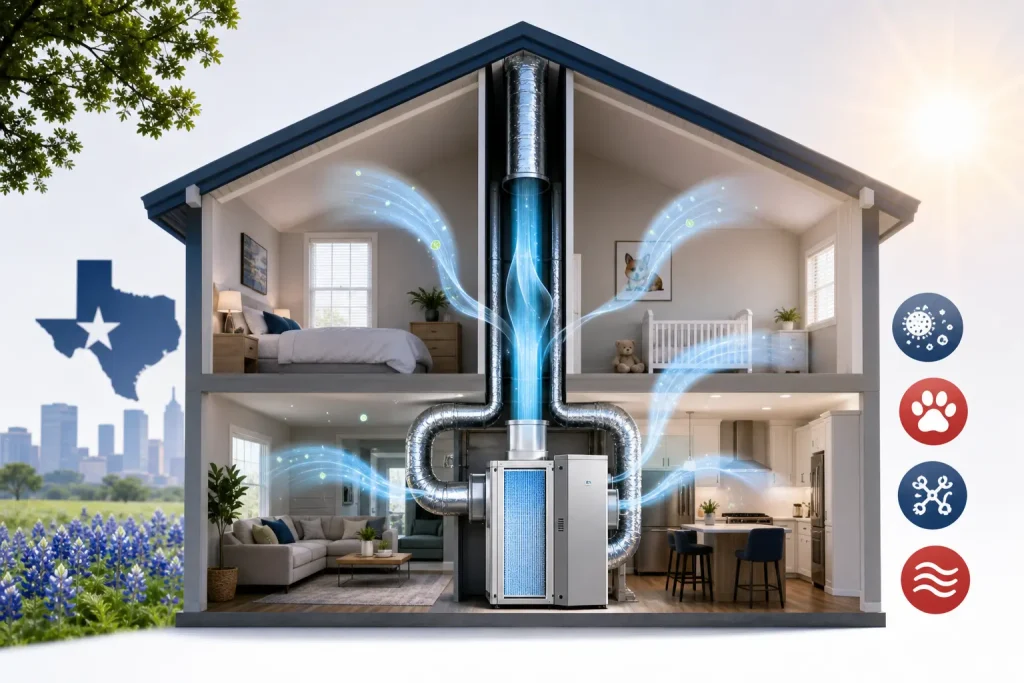
A typical central HVAC system pulls air from the home through return ducts.
That air passes through the HVAC filter or air-cleaning equipment before the system conditions and redistributes it through the supply ducts.
A simplified process looks like this:
Indoor air → Return duct → Filter/air cleaner → HVAC equipment → Supply ducts → Living spaces
A whole house air purifier is generally installed so that air moving through the HVAC system can be cleaned before it is redistributed throughout the house.
The actual performance depends on several factors.
These include:
- Filter efficiency
- Airflow
- HVAC fan operation
- Filter size
- Filter surface area
- Ductwork condition
- Home layout
- Air leakage
- Maintenance
- The type of pollutants being targeted
This is why buying the highest-rated filter available is not necessarily the correct solution.
A filter that is too restrictive for a particular HVAC system can increase resistance to airflow. ASHRAE guidance notes that increasing filter efficiency can increase pressure drop or reduce airflow, so the HVAC system should be checked before upgrading filtration.
Why Indoor Air Quality Matters in Texas
Texas homeowners have some unique indoor air quality challenges.
Homes in areas around Montgomery, Tomball, Conroe, Magnolia, Cypress, Spring, The Woodlands, Waller, and surrounding North Houston communities regularly deal with heat, humidity, pollen, dust, and long cooling seasons.
That means your HVAC system can play an important role in indoor air quality.
Humidity is especially important.
The EPA recommends keeping indoor relative humidity below 60%, with 30% to 50% generally considered an ideal range for homes. Excess moisture can encourage mold and other biological contaminants.
But humidity is only one piece of the puzzle.
Indoor air can contain particles and pollutants from both indoor and outdoor sources, including:
- Dust
- Pollen
- Pet dander
- Mold particles
- Smoke particles
- Fine particulate matter
- Household products
- Building materials
- Combustion sources
- Outdoor pollutants
The EPA identifies particles, mold, pollen, and other contaminants among common indoor pollutants.
A well-designed whole house air filtration system can help reduce some airborne particles.
However, that does not mean an air purifier removes every indoor pollutant.
That distinction is critical.
What Can a Whole House Air Purifier Remove?
The answer depends heavily on the type of air purifier.
A mechanical filter is primarily designed to capture particles.
Depending on the filter’s efficiency, these particles can include:
- Household dust
- Pollen
- Some mold spores and particles
- Pet dander
- Fine particulate matter
- Some smoke particles
- Other airborne particles
The EPA explains that higher MERV ratings generally indicate greater ability to capture specific particle sizes.
However, filtration has limits.
For example, a standard mechanical filter is not automatically designed to remove gases or odors.
The EPA notes that air cleaners without specialized media such as activated carbon or alumina generally do not remove gaseous pollutants.
That means homeowners should be careful about claims such as:
“This one device removes everything from your indoor air.”
Indoor air quality is more complicated than that.
MERV Ratings: What Texas Homeowners Should Know
If you are researching a whole house air purifier, you will probably encounter the term MERV.
MERV stands for Minimum Efficiency Reporting Values.
It is a standardized rating used to describe the particle filtration performance of HVAC filters.
The EPA explains that MERV measures a filter’s ability to capture particles between approximately 0.3 and 10 microns. Higher MERV ratings generally represent greater filtration efficiency for specified particle sizes.
For homeowners, the important point is simple:
Higher filtration efficiency is not the only consideration. The HVAC system must also be capable of moving air through the filter.
For example, replacing a basic filter with a significantly more restrictive filter without checking the equipment can create airflow problems.
The EPA recommends MERV 13 or the highest-rated filter that the HVAC system’s fan and filter slot can accommodate.
ASHRAE likewise cautions that higher-efficiency filtration can create greater pressure drop and that HVAC compatibility should be verified before making an upgrade.
This is one reason professional HVAC evaluation can be useful.
Is MERV 13 Enough for a Texas Home?
For many homes, MERV 13 can be an excellent filtration upgrade.
But “enough” depends on the home’s needs.
A homeowner mainly concerned about ordinary household dust may not need the same setup as a family dealing with significant pollen exposure, pets, wildfire smoke, or other particulate concerns.
MERV 13 is not a magic number that automatically makes indoor air clean.
The EPA describes MERV 13 or higher as capable of capturing smaller particles, while also recommending that homeowners choose the highest rating their HVAC system can properly accommodate.
A professional can evaluate:
- Existing filter size
- Filter depth
- Available filter surface area
- Blower capacity
- Static pressure
- Duct design
- Equipment specifications
- Airflow
- System age
- Maintenance condition
The goal should be effective filtration without compromising HVAC performance.
Whole House Air Purifier vs. Portable Air Purifier
One of the biggest questions homeowners have is whether they actually need a whole house air purifier.
Why not just buy a portable HEPA air purifier?
There are advantages to both.
Portable Air Purifier
A portable air purifier is designed to clean air in a specific room or area.
It can make sense if you want additional filtration in:
- A bedroom
- Home office
- Nursery
- Living room
- Pet area
- Other frequently occupied spaces
Portable systems can also be useful when you do not want to modify your HVAC system.
Whole House Air Purifier
A central HVAC air purifier works with the home’s existing air distribution system.
The goal is to provide filtration throughout the house rather than relying on individual units.
This can be convenient because homeowners do not need to move portable equipment from room to room.
The EPA notes that central HVAC filters are designed to filter air throughout a home, while portable air cleaners are generally intended for individual rooms or areas.
There is no universal winner.
For some homeowners, several strategically placed portable units may make more financial sense.
For others, a properly designed whole house air filtration system is more convenient.
Whole House Air Purifier vs. HEPA Air Purifier
Another common source of confusion is the word HEPA.
HEPA filters are highly efficient mechanical filters. The EPA explains that HEPA filters are a type of pleated mechanical air filter commonly used in portable air cleaners and are not rated using the MERV system.
A HEPA filter and a MERV-rated HVAC filter are therefore not exactly the same thing.
Installing a true HEPA filter into a conventional residential HVAC system is not as simple as replacing the existing filter.
The pressure drop and airflow requirements can be substantially different.
That is why homeowners should not assume:
“HEPA is better, so I should put a HEPA filter in my existing AC.”
The correct question is:
“What filtration level can my HVAC system safely and effectively support?”
In some homes, a properly designed high-efficiency HVAC filtration system may be the better solution.
Can a Whole House Air Purifier Help With Allergies?
It can help reduce airborne particles that contribute to indoor exposure, but it is not an allergy cure.
This distinction matters.
Pollen, dust, pet dander, and other allergens can settle on floors, furniture, bedding, curtains, and other surfaces.
An HVAC filter can capture particles while they are airborne, but it cannot remove allergens that have already settled on surfaces.
The EPA notes that air cleaners may reduce exposure to some particles, but many larger allergens are often found on surfaces rather than remaining airborne.
For homeowners concerned about allergies, a more complete strategy can include:
- Proper HVAC filtration
- Regular filter replacement
- Vacuuming
- Dust control
- Bedding maintenance
- Moisture control
- Proper ventilation
- Keeping windows closed during high-pollen periods when appropriate
- Cleaning HVAC components
- Addressing ductwork problems
- Controlling indoor sources
A whole house air purifier can be one part of that strategy.
Can a Whole House Air Purifier Help With Dust?
Yes, filtration can help capture airborne dust particles.
But there is an important catch.
If your home has excessive dust, the air purifier may not be the root solution.
Dust can enter from:
- Doors
- Windows
- Leaky ductwork
- Attic spaces
- Crawlspaces
- Construction materials
- Clothing
- Pets
- Outdoor air
- Poor housekeeping
- HVAC system issues
If a large amount of dust is entering the home through duct leakage or other pathways, simply installing a stronger air filter may not solve the underlying problem.
This is why a good HVAC evaluation should look beyond the filter.
Can a Whole House Air Purifier Help With Pollen?
This is one of the more practical reasons to consider upgraded HVAC filtration in Texas.
Outdoor pollen can enter homes through doors, windows, infiltration, and ventilation.
Once pollen becomes airborne, a properly selected HVAC filter can capture a portion of it as air circulates through the system.
However, the HVAC system only filters air when the fan is operating.
The EPA specifically notes that HVAC systems filter air when the fan is running and that homeowners can consider longer fan operation where appropriate.
That does not mean your blower should run continuously without considering energy use, humidity, and equipment design.
In a humid Texas climate, continuous fan operation can have drawbacks in certain circumstances.
A professional can help determine the appropriate operating strategy for your system.
Can a Whole House Air Purifier Remove Mold?
This is where homeowners need to be especially careful.
An air purifier does not fix a mold problem.
It may capture some airborne particles associated with mold, but it does not eliminate the moisture source that allowed mold to grow.
The EPA is very clear that air cleaners and HVAC filters do not solve mold problems. Mold is fundamentally a moisture problem, and the moisture source must be corrected.
Potential moisture sources include:
- Plumbing leaks
- Roof leaks
- Condensation
- High indoor humidity
- AC drain problems
- Wet insulation
- Poor ventilation
- Water intrusion
- Leaking ducts
- Drain pan problems
If you smell a persistent musty odor or see visible mold, installing an air purifier should not be considered the complete solution.
First identify and correct the moisture issue.
Why Humidity Control Matters More Than Many Air Purifier Sales Pitches Suggest
Texas homeowners often focus heavily on filtration.
But humidity deserves equal attention.
The EPA recommends keeping indoor relative humidity below 60%, ideally between 30% and 50%.
High humidity can contribute to conditions favorable to mold and other biological contaminants.
Your air conditioner naturally removes some moisture as it cools the air.
However, an oversized AC system can sometimes cool a space quickly without running long enough to remove as much moisture as desired.
This is one reason proper HVAC sizing matters.
A whole house air purifier cannot compensate for an AC system that is poorly sized, poorly maintained, or unable to manage indoor humidity.
If your home feels cool but damp, the right solution may involve investigating:
- AC sizing
- Cooling coil condition
- Refrigerant-related issues
- Airflow
- Ductwork
- Drainage
- Thermostat settings
- Ventilation
- Dehumidification
What About UV Air Purifiers?
Some whole house air purification systems use ultraviolet light.
UV technology is different from mechanical filtration.
A UV system is generally intended to expose microorganisms or surfaces inside HVAC equipment to ultraviolet light.
But performance depends heavily on system design, exposure time, lamp intensity, placement, cleanliness, and other factors.
UV should therefore not automatically be treated as a replacement for filtration.
A homeowner interested in indoor air quality may benefit from combining technologies when there is a clear reason to do so.
For example:
Mechanical filtration + humidity control + source control
may be more important than simply adding more technology.
What About Ionizers and Bipolar Ionization?
This is an area where homeowners should do extra research before purchasing.
Ionization systems use electrically charged particles or ions as part of their air-cleaning process.
Some systems use bipolar ionization technology.
The EPA says bipolar ionization is an emerging technology and that there is less research evaluating it outside laboratory conditions compared with established technologies such as filtration. The EPA also notes that bipolar ionization can potentially generate ozone and other by-products unless appropriate precautions are taken.
The EPA recommends looking for UL 2998 certification when considering bipolar ionization products because that standard addresses zero ozone emissions from air cleaners.
That does not mean every ionization product is automatically unsafe.
It means homeowners should ask questions and look for credible evidence rather than relying only on marketing claims.
Be Careful With Ozone-Generating Air Purifiers
This deserves a separate warning.
Ozone is not something you should intentionally add to occupied indoor air as a general air-cleaning strategy.
The EPA identifies ozone as a lung irritant and warns about ozone-generating air cleaners.
The EPA also states that ozone generators have limited ability to remove many indoor contaminants at concentrations that do not exceed public health standards.
If you are shopping for a whole house air purifier, ask whether the system intentionally generates ozone.
If it does, research the technology carefully before installation.
For many homeowners, mechanical filtration is the simpler and more established starting point.
What Are the Benefits of a Whole House Air Purifier?
A properly selected whole house air purifier can offer several benefits.
1. Whole-Home Filtration
Instead of cleaning only one room, the HVAC system can filter air throughout the home as air circulates.
2. Better Control of Airborne Particles
High-efficiency filtration can reduce airborne particles such as dust, pollen, and other particulate matter.
3. Convenience
You do not have to move a portable air purifier between rooms.
4. Integration With Your Existing HVAC System
A properly installed system can become part of your existing heating and cooling equipment.
5. Potentially Better Indoor Air Quality
Filtration is one component of an overall indoor air quality strategy recommended by the EPA.
6. Less Visible Equipment
Instead of placing several portable units around the house, a central system can keep the air-cleaning equipment integrated into the HVAC system.
What Are the Disadvantages?
A whole house air purifier is not perfect.
Potential disadvantages include:
Installation Cost
A central system usually costs more upfront than simply buying a portable air purifier.
Filter Replacement
High-efficiency filters still require regular replacement.
Airflow Restrictions
A more restrictive filter can increase pressure drop and affect airflow if the HVAC system is not designed for it.
Limited Effect on Gases
Standard particle filters do not automatically remove gaseous pollutants or VOCs.
It Does Not Fix Mold
Moisture problems must still be addressed.
It Does Not Replace Ventilation
Filtration is not the same as bringing clean outdoor air into the home.
Technology Quality Varies
Not every air-cleaning technology has the same level of evidence behind it.
How Much Does a Whole House Air Purifier Cost in Texas?
The cost can vary significantly depending on the technology and installation requirements.
There is no single price that applies to every Texas home.
A basic HVAC filtration upgrade may be relatively inexpensive if the existing system already has an appropriate filter cabinet.
A more advanced whole house air cleaner may require:
- A new filter cabinet
- Electrical work
- Control wiring
- Duct modifications
- Larger filter media
- Additional equipment
- Professional installation
- Future filter replacements
UV systems, electronic air cleaners, activated carbon systems, and combination systems can also have different installation and operating costs.
For that reason, homeowners should be cautious about websites that advertise one universal “whole house air purifier cost.”
The actual price should be based on the HVAC system and the type of air quality problem being addressed.
A professional HVAC contractor can inspect the system and provide an equipment-specific recommendation.
Is a Whole House Air Purifier Worth It in Texas in 2026?
For many Texas homeowners, yes.
But I would not recommend installing one simply because someone says every home needs an air purifier.
A whole house air purifier makes the most sense when there is a clear reason for improving filtration or indoor air quality.
You may be a good candidate if:
- Your home has excessive airborne dust.
- You have pets.
- You regularly deal with pollen.
- You want improved whole-home filtration.
- You have an existing central HVAC system.
- Your current filtration system is inadequate.
- You are replacing or upgrading HVAC equipment.
- You want a more convenient alternative to several portable air cleaners.
- Your household has specific concerns about airborne particles.
- You want to improve your overall indoor air quality strategy.
On the other hand, an air purifier may not be the first solution if your biggest problem is:
- Excess humidity
- A plumbing leak
- Roof leakage
- Visible mold
- Severe duct leakage
- Poor HVAC sizing
- Inadequate ventilation
- An AC system that is not operating correctly
Those problems should be addressed first.
When Should You Add a Whole House Air Purifier?
There are several situations when adding an air purifier during HVAC work makes practical sense.
During AC Replacement
If you are already replacing your central air conditioner or heat pump, it may be an appropriate time to evaluate the filtration system.
The HVAC contractor can assess the filter cabinet, airflow, blower capacity, and ductwork before selecting an air-cleaning system.
During a Ductwork Upgrade
If your ductwork is being replaced or modified, an air filtration upgrade may be easier to integrate into the system.
During a Home Renovation
Renovation activities can generate significant dust and particles.
Long-term filtration improvements may be worth considering after the project.
When Indoor Air Quality Is a Persistent Concern
If you constantly notice dust, odors, or airborne particles despite regular cleaning and normal HVAC maintenance, an indoor air quality evaluation may help identify the cause.
What Should You Ask an HVAC Contractor Before Installing One?
Do not simply ask:
“How much is a whole house air purifier?”
Ask better questions.
1. What problem is this system solving?
Is it dust?
Pollen?
Particles?
Odors?
Humidity?
Something else?
2. What filter rating does it use?
Ask about MERV and the filter’s actual dimensions.
3. Can my HVAC system handle it?
This is critical.
4. Will it affect airflow?
Ask whether airflow or static pressure will be measured.
5. How often does the filter need to be replaced?
The answer affects long-term ownership cost.
6. Does the system generate ozone?
If yes, ask for documentation and certification.
7. Does it remove gases or odors?
If that is your goal, you may need activated carbon or another specialized technology.
8. Will it solve my humidity problem?
Usually, an air purifier is not a substitute for proper humidity control.
9. Is my ductwork leaking?
If your ducts are leaking, improving filtration may not solve the underlying air quality problem.
10. What maintenance does the system require?
Every system needs maintenance.
Whole House Air Purifier Installation: Why HVAC Compatibility Matters
One of the biggest mistakes homeowners can make is buying an air-cleaning product first and asking about HVAC compatibility later.
Your HVAC system is a complete system.
The blower, coil, filter, ductwork, return size, supply design, and controls all work together.
Changing one component can affect the others.
For example, a filter with higher resistance can affect airflow.
Reduced airflow can potentially affect system performance, comfort, and equipment operation.
ASHRAE specifically recognizes the relationship between filter efficiency, pressure drop, and airflow.
That is why professional installation is about more than cutting a hole in the duct and installing a product.
The contractor should consider the entire HVAC system.
Can a Whole House Air Purifier Lower HVAC Efficiency?
It can, depending on the equipment and installation.
A more restrictive filter can increase resistance to airflow.
If the system was not designed to accommodate that resistance, airflow can be reduced.
That does not mean high-efficiency filtration is bad.
It means the filter and HVAC system need to be properly matched.
A larger media filter with greater surface area may sometimes provide high filtration efficiency with less resistance than trying to force a very restrictive filter into a small filter slot.
This is another reason filter size and cabinet design matter.
Does an Air Purifier Make Your House Smell Better?
It depends on the source of the odor.
Particle filtration can help with some odors when odor-causing particles are captured.
But many odors come from gases or volatile compounds.
The EPA notes that air cleaners without specialized media such as activated carbon generally do not remove gaseous pollutants.
So if your goal is odor reduction, ask specifically about the filtration media being used.
Also investigate the source.
Persistent odors can sometimes point to:
- Mold or moisture
- Dirty HVAC components
- Drain problems
- Plumbing issues
- Pet sources
- Smoke
- Building materials
- Poor ventilation
An air purifier should not simply be used to hide an underlying problem.
Whole House Air Purifier for Homes in Montgomery, TX
Montgomery-area homeowners deal with long cooling seasons and humid conditions.
That makes HVAC maintenance, filtration, and humidity control important parts of maintaining comfortable indoor spaces.
If you are considering a whole house air purifier in Montgomery, TX, the first step should be evaluating your existing HVAC system.
A professional can determine whether your current filter, ductwork, airflow, and equipment are appropriate for an upgraded filtration system.
The right solution may be as simple as improving the filter.
In other cases, a dedicated whole house air cleaner may make more sense.
Whole House Air Purifier for Tomball, TX Homes
Tomball homeowners can also benefit from evaluating indoor air quality as part of regular HVAC care.
Homes exposed to outdoor dust and pollen can benefit from effective particle filtration.
However, filtration should be considered alongside ductwork condition, humidity, ventilation, and regular HVAC maintenance.
If you are researching whole house air purifier installation in Tomball, TX, ask the HVAC contractor to evaluate the complete system rather than simply recommending the most expensive air cleaner.
Whole House Air Purifier for Conroe, Magnolia, and The Woodlands
The same basic principle applies throughout the Greater North Houston area.
Whether you live in Conroe, Magnolia, The Woodlands, Spring, Waller, Cypress, Willis, Hockley, or a nearby community, your home’s indoor air quality is influenced by more than the air filter.
Your home’s construction, HVAC equipment, ductwork, humidity, outdoor air infiltration, and indoor activities all play a role.
A whole house air purifier can be valuable, but it should be part of a broader indoor air quality strategy.
7 Signs You May Need Better HVAC Air Filtration
Here are some signs that it may be worth investigating your home’s air filtration system.
1. Dust Builds Up Quickly
If surfaces become dusty soon after cleaning, investigate the source before simply installing a stronger filter.
2. You Notice Heavy Pollen Indoors
Effective filtration can help reduce airborne pollen.
3. You Have Pets
Pet dander and other airborne particles can be captured by appropriate filtration.
4. Your Current Filter Is Very Basic
If your system has an older or low-efficiency filter setup, an HVAC professional may be able to recommend a better option.
5. Your Home Has Persistent Airborne Particles
Visible particles or persistent dust can justify an indoor air quality evaluation.
6. You Are Replacing Your HVAC System
A new HVAC installation is a good time to consider filtration and indoor air quality.
7. You Want Whole-Home Filtration
If you dislike having multiple portable air purifiers around the house, central filtration may be worth considering.
5 Things a Whole House Air Purifier Cannot Do
It is equally important to understand the limitations.
1. It Cannot Fix a Water Leak
Moisture problems must be corrected.
2. It Cannot Remove All Mold From a Building
Mold remediation and moisture control may be necessary.
3. It Cannot Replace Proper Ventilation
Filtration and ventilation are different strategies.
4. It Cannot Guarantee Perfect Indoor Air
No air cleaner removes every pollutant.
5. It Cannot Fix a Bad HVAC System
If your AC is improperly sized, poorly maintained, or suffering from airflow problems, an air purifier is not a replacement for HVAC repair.
The EPA recommends combining source control, ventilation, and filtration rather than relying on a single strategy.
The Best Whole House Air Purifier Is Not Necessarily the Most Expensive One
This is an important point for homeowners.
There is a tendency in the HVAC industry to compare air cleaners based on features.
More technology does not necessarily mean better results for your particular house.
A homeowner with a properly sized central AC system and a well-designed MERV 13 filtration setup may already have an effective solution for particulate filtration.
Another home may benefit from a larger media filter.
Another may need activated carbon because odor and gaseous pollutants are a priority.
Another may need humidity control before spending money on air purification.
The best solution is therefore the one that addresses the actual problem.
A Practical Whole House Indoor Air Quality Strategy for Texas Homes
Instead of thinking only about air purification, consider your home in five steps.
Step 1: Control the Source
Find and reduce sources of indoor pollutants.
Step 2: Control Moisture
Keep humidity under control and address leaks quickly.
The EPA recommends indoor relative humidity below 60%, ideally 30% to 50%.
Step 3: Improve Filtration
Use an HVAC filter that the system can safely accommodate.
Step 4: Improve Ventilation When Appropriate
Ventilation can help dilute indoor pollutants.
Step 5: Add Supplemental Air Cleaning
If needed, add a whole house air purifier or other air-cleaning technology.
This approach is much more useful than treating an air purifier as a magic solution.
So, Is a Whole House Air Purifier Worth It in 2026?
For many Texas homeowners, a whole house air purifier is worth considering, but the answer depends on the home and HVAC system.
If your primary concerns are airborne dust, pollen, pet dander, and particulate matter, improving HVAC filtration can be a practical upgrade.
If you are building or replacing an HVAC system, it can also be a convenient time to incorporate a properly sized whole house air filtration system.
But if your primary problem is mold, high humidity, odors, or poor ventilation, an air purifier alone may not solve it.
The best approach is to identify the problem first and choose the technology second.
For most homeowners, a properly matched mechanical filtration system is a logical starting point. The EPA recommends considering MERV 13 or the highest filter rating that your HVAC system can safely accommodate, while professional evaluation can help verify airflow and equipment compatibility.
And when considering electronic or ionization technologies, pay attention to ozone emissions and independent safety information.
Whole House Air Purifier FAQs
Is a whole house air purifier worth the money?
It can be. A whole house air purifier may be worthwhile if you want improved whole-home particle filtration, have significant dust or pollen concerns, have pets, or want an alternative to multiple portable air cleaners. The value depends on the equipment, installation, maintenance, and the specific indoor air quality problem.
What is the best MERV rating for a home?
There is no single MERV rating that is ideal for every home. The EPA recommends MERV 13 or the highest-rated filter that the HVAC system can accommodate.
Can I install a MERV 13 filter in any HVAC system?
Not necessarily. The filter must be compatible with the HVAC equipment and filter cabinet. Higher-efficiency filters can create greater airflow resistance, so system compatibility should be checked first.
Does a whole house air purifier remove mold?
It can capture some airborne mold-related particles, but it does not solve the moisture problem that causes mold growth. The EPA specifically states that air cleaners do not address the cause of mold.
Does an HVAC air purifier help with pollen?
Yes, appropriate mechanical filtration can help capture airborne pollen as air circulates through the HVAC system. It will not remove pollen that has already settled on surfaces.
Is a whole house air purifier better than a portable HEPA purifier?
Not automatically. A whole house system provides central filtration, while portable HEPA units can provide concentrated filtration in individual rooms. The best choice depends on the home’s layout, HVAC system, budget, and indoor air quality goals.
Does a whole house air purifier reduce dust?
It can reduce airborne dust particles that pass through the HVAC filter. However, excessive dust may also indicate duct leakage, air infiltration, construction dust, or other sources that should be investigated.
Can an air purifier remove odors?
Some systems can reduce certain odors, particularly when they contain appropriate adsorption media such as activated carbon. Standard particle filters are not designed to remove all gaseous pollutants.
Does a whole house air purifier use more electricity?
The answer depends on the system. Mechanical filtration itself does not necessarily require separate electrical power, while some electronic or UV systems do. HVAC fan operation also affects energy use.
Should my HVAC fan run continuously to filter my home’s air?
Not necessarily. Running the fan longer can increase filtration because the HVAC filter works while air is circulating, but continuous fan operation can have energy and humidity implications. The appropriate setting depends on the equipment and home.
Are ozone air purifiers safe?
The EPA warns that ozone is a lung irritant and advises against ozone-generating air cleaners as a general indoor air-cleaning strategy.
Is bipolar ionization safe?
The EPA considers bipolar ionization an emerging technology with less real-world evidence than established filtration technologies and notes the potential for ozone and other by-products. If considering it, look for appropriate independent testing and UL 2998 zero-ozone certification.
How often should a whole house air purifier filter be changed?
It depends on the filter type, home conditions, system design, and manufacturer’s instructions. Homes with pets, construction dust, heavy pollen, or other high particle loads may require more frequent replacement.
Can an air purifier replace HVAC maintenance?
No. Air purification does not replace AC maintenance, filter replacement, duct inspection, coil cleaning, drain maintenance, or other HVAC services.
Final Verdict: Should You Add a Whole House Air Purifier to Your Texas HVAC System?
If you are looking at your HVAC system in 2026 and wondering whether a whole house air purifier is worth adding, the answer is:
It can be a very worthwhile upgrade when it is selected for the right reason and properly matched to the HVAC system.
For a Texas homeowner dealing with dust, pollen, pet dander, or other airborne particles, improved HVAC filtration can provide a practical way to support better indoor air quality.
But do not overlook the basics.
A clean HVAC system, properly sized equipment, good airflow, sound ductwork, effective moisture control, appropriate ventilation, and regular filter replacement all matter.
An air purifier should complement those things, not replace them.
Before purchasing a system, have your HVAC equipment evaluated. Ask what filtration level the system can safely handle, whether airflow and static pressure need to be checked, what pollutants the proposed technology actually removes, how often filters need to be replaced, and whether the system produces ozone.
The goal should not be to buy the most advanced air purifier on the market. The goal should be to create the right indoor air quality solution for your Texas home.
If you are in Montgomery, Tomball, Conroe, Magnolia, Spring, The Woodlands, Waller, or another Greater North Houston community, an HVAC professional can evaluate your existing system and help determine whether a simple filtration upgrade or a dedicated whole house air purification system makes more sense.
Good indoor air quality starts with understanding the problem.
Then you choose the right solution.
Sources and Research Notes
This article was reviewed against current EPA and ASHRAE guidance available in 2026, including information on HVAC filtration, MERV ratings, indoor humidity, air cleaners, ozone-generating technologies, and bipolar ionization.
Key sources include:
- U.S. Environmental Protection Agency, Guide to Air Cleaners in the Home.
- U.S. Environmental Protection Agency, What Is a MERV Rating?
- U.S. Environmental Protection Agency, What Kind of Filter Should I Use in My Home HVAC System?
- U.S. Environmental Protection Agency, Air Cleaners and Air Filters in the Home.
- U.S. Environmental Protection Agency, Care for Your Air: A Guide to Indoor Air Quality.
- U.S. Environmental Protection Agency, What Are Ionizers and Other Ozone Generating Air Cleaners?
- U.S. Environmental Protection Agency, Bipolar Ionization Guidance.
- U.S. Environmental Protection Agency, Biological Contaminants and Indoor Air Quality.
- ASHRAE guidance on residential filtration and the relationship between filter efficiency, pressure drop, and airflow.