

How to Clean Your AC Condenser Unit: A Step-by-Step Guide for Texas Homeowners
If your air conditioner is struggling to keep up on a 95-degree afternoon in Conroe or Cypress, a dirty condenser unit is one of the most likely reasons. The outdoor unit collects dust, cottonwood, grass clippings, and whatever else a Texas summer throws at it. When that buildup gets thick enough, your system works harder, runs longer, and wears out faster than it should.
The good news: cleaning your condenser is something most homeowners can handle in under an hour. This guide walks you through the process step by step — what tools you need, how to do it safely, and when it makes more sense to call a professional.
What the Condenser Unit Actually Does
The condenser is the large metal box sitting outside your home. It houses the compressor, condenser coils, and a fan, and its job is to release the heat that your indoor unit pulls from your home’s air.
When the coils and fins are coated in grime, they can’t shed heat efficiently. The system compensates by running longer cycles, which drives up your electricity bill and puts extra strain on the compressor. In Texas, where your AC might run eight to twelve hours a day through the summer, that inefficiency adds up quickly.
What You’ll Need Before You Start
Gather these before heading outside:
- Flathead and Phillips screwdrivers
- Garden hose with an adjustable nozzle (no pressure washer)
- Fin comb or soft brush
- Foaming coil cleaner spray (no-rinse type works well)
- Work gloves
- Safety glasses
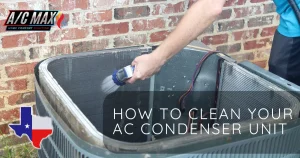
Step-by-Step: How to Clean Your AC Condenser Unit
Step 1: Turn Off Power at the Disconnect Box
Don’t skip this. Find the outdoor disconnect box mounted on the wall near the unit, open it, and pull out the disconnect block or flip the switch off. Then go to your breaker panel and shut off the AC breaker as well.
If you’re not sure which breaker controls the outdoor unit, turn off the entire AC circuit. Confirm the unit is off before you touch anything.
Step 2: Clear the Area Around the Unit
Remove any leaves, grass, or vegetation within two feet of the condenser. Trim back shrubs that have crept too close. The unit needs open airflow on all sides to do its job properly.
If your unit design allows it, remove the top grille or fan cover — most have four to six screws around the perimeter. Set the cover aside carefully without pulling on the wiring attached to the fan motor.
Step 3: Pull Out Loose Debris
With the fan cover off, use your hand or a soft brush to clear out any leaves, twigs, or cottonwood that have collected inside. Cottonwood season in spring is especially rough on condenser units in areas like Tomball and Magnolia — it can pack the fins so tightly that airflow drops noticeably.
Avoid using a shop vacuum here unless you have a soft brush attachment. Hard contact with the aluminum fins can bend them.
Step 4: Apply Coil Cleaner
Spray the foaming coil cleaner across the outside of the fins, working your way around the entire unit. Let it sit for the dwell time listed on the product — usually five to ten minutes. The foam loosens built-up grime, oil, and oxidation that a hose alone won’t touch.
No coil cleaner on hand? A mild dish soap diluted in water works as a substitute, though it takes more rinsing to clear.
Step 5: Rinse From the Inside Out
This is where most homeowners go wrong. You want to rinse from the inside of the unit outward through the fins — not from the outside in. Spraying from the outside pushes debris deeper into the coil.
Use a garden hose on a gentle stream setting. Work in sections and rinse until the water runs clear, keeping the stream moving rather than holding it in one spot.
Don’t use a pressure washer. The fins are thin aluminum and will bend under high pressure. Bent fins restrict airflow and are difficult to fully straighten.
Step 6: Straighten Any Bent Fins
Once the unit is rinsed, look for sections where the fins are bent or matted together. A fin comb — available at most hardware stores — can straighten them. Run it gently along the fins in the direction of the grooves.
It’s worth taking your time here. Even a small section of crushed fins can meaningfully reduce airflow across the entire coil face.
Step 7: Reassemble and Restore Power
Replace the fan cover and tighten all screws. Make sure no wiring is pinched. Reinsert the disconnect block or flip the switch back on, then restore the breaker.
Wait five minutes before switching the thermostat to cooling mode — this gives the capacitor and compressor time to stabilize. Then set the thermostat a few degrees below the current indoor temperature and listen for the unit to start normally.
How Often Should You Clean the Condenser?
For most Texas homes, once a year is the minimum. Twice is better — once in early spring before the heavy cooling season kicks in, and again in fall.
If your home is surrounded by trees, near a construction site, or in an area with heavy cottonwood, you may need to rinse the unit every few months during peak seasons.
Signs the Unit Needs More Than a Cleaning
Cleaning the condenser improves efficiency, but it won’t fix mechanical problems. If you notice any of the following after cleaning, it’s time to call a technician:
- The unit runs but the air inside isn’t getting cold
- You hear grinding, rattling, or loud humming from the unit
- The unit trips the breaker after restarting
- Ice forms on the refrigerant lines or on the unit itself
- The fan isn’t spinning while the compressor is running
These symptoms point to refrigerant issues, capacitor failure, compressor problems, or electrical faults — none of which are DIY repairs.
When to Call a Professional Instead
If the fins are heavily damaged, the coils look corroded, or you’re not comfortable working around electrical components, a professional cleaning as part of a maintenance visit is the smarter move.
A trained technician will also check refrigerant levels, test electrical components, inspect the capacitor, and verify the system is running within normal parameters — well beyond what a garden hose can accomplish.
AC Max serves homeowners in Montgomery, Tomball, Cypress, Magnolia, Conroe, and Waller with full HVAC maintenance, repair, and installation. If your system needs more than a rinse, their team can diagnose and fix what’s actually wrong.
Keeping the Area Clean Year-Round
A few simple habits will cut down on how often you need to do a deep clean:
- Keep grass trimmed short around the unit so clippings don’t get pulled into the fins
- Don’t stack anything against or on top of the unit
- After a storm, check for leaves and debris packed against the sides
- During cottonwood season, check weekly if you have trees nearby
Small habits, real difference — especially during the months when Texas heat is at its worst.
FAQs
Can I clean my AC condenser unit with a pressure washer?
No. Pressure washers will bend the aluminum fins and can damage the coil. Use a standard garden hose on a gentle stream setting. The fins are fragile and need low-pressure water to rinse safely.
How do I know if my condenser coils are actually dirty?
Look at the fins on the outside of the unit. If you can see a visible layer of dust, debris, or cottonwood matted against the surface — or if the fins look gray or brown instead of metallic — the unit needs cleaning. You can also run the system and feel whether warm air is pushing out of the top. If it isn’t, airflow may be restricted.
Is it safe to clean the condenser myself?
Yes, as long as you shut off power at both the disconnect box and the breaker before touching the unit. Never work on it with power on. If you’re not confident about the electrical steps, schedule a professional maintenance visit instead.
How long does it take?
Most homeowners finish in 30 to 60 minutes, depending on how dirty the unit is and whether any fins need straightening. First-timers should budget closer to an hour.
Will cleaning the condenser lower my electricity bill?
It can. A clean condenser releases heat more efficiently, which means shorter run cycles. In Texas, where AC systems run heavily from April through October, even a modest efficiency gain shows up on your monthly bill over time.
What if the fins are severely bent or the coils look corroded?
Bent fins can be partially straightened with a fin comb, but severe damage or corrosion is a job for a technician. Corroded coils can develop refrigerant leaks, which require professional repair — not a homeowner fix.
How is a DIY cleaning different from a professional tune-up?
A DIY cleaning removes surface debris and improves airflow. A professional tune-up also covers refrigerant level checks, electrical component testing, capacitor inspection, and a full system performance evaluation. Both have value, but they’re not substitutes for each other.
Cleaning your condenser once or twice a year is one of the simplest things you can do to protect your HVAC investment and keep your home comfortable through a Texas summer. Do it before the heat peaks, and your system will reward you with fewer breakdowns and lower energy bills. If you run into something that goes beyond the garden hose, AC Max is ready to help.